
Leicester Cathedral
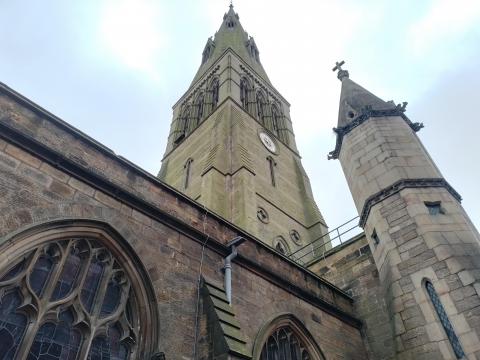
I caught to 6.15 from Barnoldswick on Monday morning and then the train from Preston down to Birmingham and from there to Leicester. Another cathedral was in my sights, and within five hours of leaving my house, I had ticked it off. Although it must be one of the smallest English cathedrals and is architecturally unthrilling on account of its largely Victorian structure, it occupies an ancient site. Furthermore, its profile and revenues were given a shot in the arm this century when King Richard III’s body was found under a nearby carpark and the Home Office specified that any human remains’ reinterment should be in the nearest consecrated ground. To the chagrin of Roman Catholics who claimed Richard as one of their own, and the good folk of York who coveted the remains of the last Yorkist king, Leicester Cathedral got the prize.
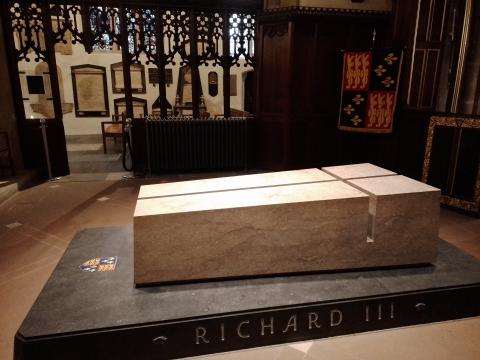
It was a prize worth getting. A King Richard III Centre opened across the road, entry to which cost me twelve and a half pounds. The tomb itself seems to require 1-2 permanent guides to inform the ignorant and/or guard the treasure. The large slab of Swaledale stone which covers the site cannot be stolen, but it might it be defaced considering Richard’s historically poor reputation and possibility he murdered his little nephews.
There was something appropriately medieval about the whole visit. It was as though monks from the year 1200 had procured the bones of some saint or a piece of the True Cross and pious folk from the known world were duly queueing up to pay respects and absorb the atmosphere. Though Richard Plantagent’s reputation has been rehabilitated in recent years, few would suggest he was exceptionally righteous or holy, or a worker of miracles. Those who came were simply curious or wanted to see what all the fuss was about.
I have been to the tomb of Jesus Christ, too. Or rather, I have been to the two places which make reasonable claims to that effect. Thankfully, both are empty, for that Victim of human violence could not be held by death and He came back to life three days later. If Richard of Gloucester (or is it now Richard of Leicester?) trusted Jesus Christ for his salvation and not the papistic church to which he so very much belonged, then he, too, shall find the tomb no prison.
A D
- Log in to post comments

 Sunday Worship 10.45am & 6.00pm