
Gables of St Peter's, Pwllheli
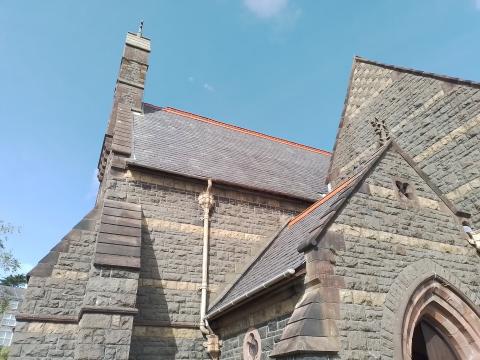
The Parish Church of St. Peter, in Pwllheli, Gwynedd. There was some function taking place within, so the externals only I was able to observe. It seemed fairly ordinary but for the number of gables it seemed to possess. With hindsight, this is unremarkable, but at the time I pondered it. A gable is the triangular ‘end’ of a building, formed by two intersecting roof slopes.
The term likely originated from the Proto-Germanic root gablaz or the Old Norse word gafl, which may mean roof top, or it is linked to words for fork, such as Old English gafol, geafel, the Old Saxon gafala, Dutch gaffel, Old High German gabala ("pitchfork”) and Old Irish gabul ("forked twig"). The fork might have been the supporting feature for the two beams which allowed a sloping roof to be supported.
Okay, so that was quite a long-winded explanation. Roofs in scripture were generally flat and provided additional, and often welcome, living space. Unlike the heavy rains of Germany, Ireland, Scandinavia and England, the pitched (ie sloped) roofs of which were redesigned to bear away excess waters, middle eastern fold liked flat-topped houses. Thus, Proverbs explains, courtesy of the Geneva Bibe:
It is better to dwell in a corner of the house top, than with a contentious woman in a wide house. 21:9
I mused that, even if one had a pitched roof and two gables, living on top of it would still be preferable to sharing a home with a disagreeable, contentious, nagging partner.
- Log in to post comments
 Sunday Worship 10.45am & 6.00pm