
St Martin de Top
I continue to enjoy reading Peter Green’s Early Christianity in Britain (Day One, 2023). Like most evangelical Protestants, he is keen to demonstrate that Christianity was established on these shores well before Augustine of Canterbury appeared in the Kentish coast in AD597 on behalf of the Pope. He holds the Celtic Church in high regard, something I have resisted, perhaps as a reaction against today’s evangelical Left and Christian Climate Change brigade which both admire it. Green argues that it represented a purer Christianity than the Roman monster across the Channel and that much of its goodness was lost when Rome swallowed it up.
Likewise, as a traditional ‘Hot Prot’, I eye monasteries and abbeys with suspicion, but Green argues that they were early reactions against Church corruption and the heart of genuine Christian communities in Britain and Ireland. They were inspired by the great Martin of Tours (AD336-397), whose evangelical witness was authentic and godly. He points out that several early churches from the late British Roman period were dedicated to his memory.
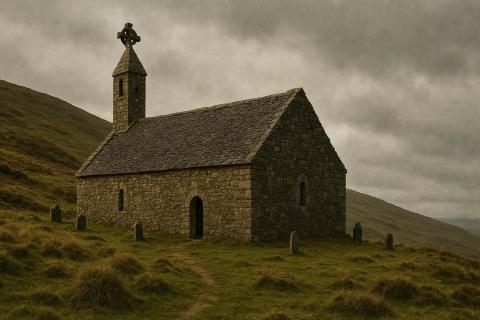
Several years ago, I pondered the name Martin Top. Our chapel is called Salem, of course, meaning 'peace', but it is better known by its locality, the hamlet outside of Rimington. The earliest uses of the name are Martinstokisclif ('stock' is a place by a cliff or hill) in 1251 and Martinestoftes deriving from Martin’s tofts (toft is likely a farm). Martin Top could have been established in Norman times when such French names were associated with landholding, or it might come from the Roman period (deriving from Mars, the war god). As there is a Roman road fifty yards from the chapel cutting through Martin Top, we know that the Romans were certainly operating in this area. It is therefore not incredible to think that the Martin of Martin Top refers to St Martin de Tours, the late Roman Christian and evangelist, after whom a place of worship might have been established in these parts 1600 years ago. Indeed, the possible remains of a medieval chapel have been cautiously identified a few fields away. Can we be certain? No. Is it even probable? Also no. Yet it is possible that the general place at which we gather for prayer and preaching each Sunday was also used for this purpose by our ancestors towards the close of the ancient world. If the Lord tarries, and Christianity continues its slow, national asphyxiation, it might be that in a thousand years’ time, our descendants once again meet to worship on our lonely hillside, a third Martin Top Chapel. Perhaps a future pastor will consider the possibility of ancient folk from the AD2000s having met on the site before him, wondering how we dressed and what we did.
...declaring the end from the beginning, and from ancient times the things that are not yet done, saying, My counsel shall stand, and I will do all my pleasure. Isaiah 46:10
A. D
- Log in to post comments
 Sunday Worship 10.45am & 6.00pm