
All Saints' Orthodox Cathedral, Camden
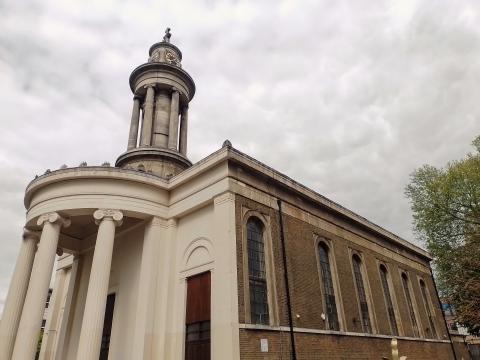
All Saints’ Greek Orthodox Cathedral sits on a busy corner of London’s Camden Town. A rather pleasant former Anglican Parish Church, it was known as Camden Chapel when it was first built in the early 1820s. As the years progressed, it took on greater ecclesiastical names: St Stephen’s, then All Saints’ Church and then, after the Second World War, the Greek Orthodox Cathedral. It has either ascended, or descended, in status, depending on one’s view point.
Lord Byron, among others, had helped the British people to develop a sympathy and love for all things Greek, and this church was built in a Greek style, with ionic capitals atop columns, all beneath a rounded portico. Above this is a rather delicate-looking tower, modelled on Athens’ Monument of Lysicrates. I doubt that those original builders, and the 3000-4000 weekly congregants in the mid-Victorian period, could foresee their building’s future usage by the very Greeks and their Orthodox Church to which it paid compliments. A classical building is certainly more appropriate for Orthodoxy than gothic.
Perhaps a building is an influence on a congregation which meets under its roof. What we put at the front, what we look at, the style of the windows etc, what if they subtly affect our beliefs and modes of worship? Moving a pulpit from the middle to the side, for instance: does this suggest a demotion of God’s word? Or, conversely, might a prominent, raised pulpit indicate too high a view of the pastor's ministry? Does a stage with a ‘worship band’ highlight the congregation’s need for entertainment? Does a piano or an organ reveal a church’s refusal to move past its Victorian heritage? Do we make our buildings, or do our buildings 'make' us? Camden Chapel was built in the style of the Greeks and to the Greeks it now belongs.
Trust ye not in lying words, saying, The temple of the Lord, The temple of the Lord, The temple of the Lord, are these. Jeremiah 7:4
A D
- Log in to post comments

 Sunday Worship 10.45am & 6.00pm