
Exeter Cathedral
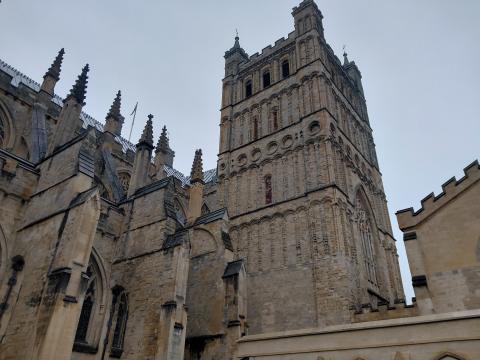
I nipped down to Bristol on Monday morning, calling at a poorly relative's in Wiltshire, before heading off to Exeter the day following. It was twenty-one year since I was last in Devonshire, my quarry this time being the cathedral which I was pleased to ‘tick-off’. Just in case my two-night journey south caused unbearable levels of homesickness for the north, God’s good providence arranged for constant rain to remind me of Lancashire. It worked, and my sodden feet were not sorry to board the train back to Bristol. Nevertheless, I have resolved to return to this neck of the woods being pleased with what I saw.
The grounds of the cathedral were somewhat cluttered with garden sheds for what the authorities shall be pleased to call Exeter’s Christas market. The site will stop resembling B&Q in a few weeks as each garden shed becomes a shop of overpriced nick-nacks and expensive street food. Despite the wooden huts, the iron skies and the incessant raindrops, the cathedral still looked rather grand. Although not the largest and tallest, its west frontage is superb, decorated with life-sized images of men and angels, reminding me somewhat of Lichfield.
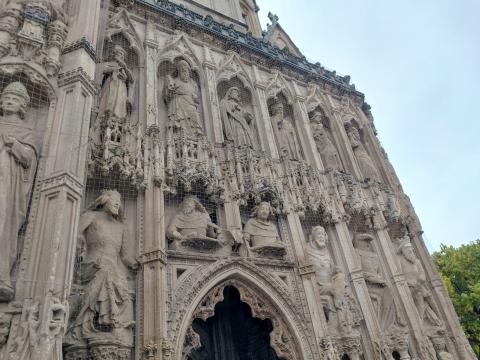
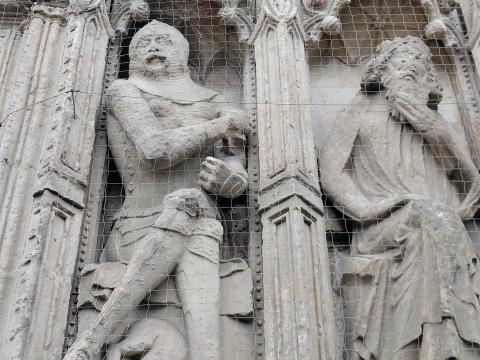
That west front's lower level hosts carvings of angels, with kings and Bishops of Exeter in the middle and other characters in the tier above them. At least two thirds of them have not been identified and those that have are still open to question. For example, some of the kings have been named as Cnut and Edward the Confessor, while some of their regal colleagues have been thought to represent the ancient kings of Judah. On the row above it is thought that the apostles and various evangelists gaze down. I was a little amused by two characters from the middle row which appear to be a knight crossing his legs and a king stroking his beard, as though the pair were patiently engaged in listening to some long and quite wearisome conversation. Hearing thousands of scholars and amateurs discussing their possible identities may well have caused their respective postures.
One might have expected angels to be at the top, kings and rulers below them and humble Christian workers at the bottom. That is certainly the hierarchy which the world would impose. In God’s ordering, however, the humblest man who trusts in Christ is of greater consequence than some godless emperor or mighty warlord, and the very angels of heaven, despite their shimmering brilliance, are in awe of those folk for whom their Maker gave His life. Perhaps those 'ignorant' medieval masons who constructed that facade knew more of God’s sociology than us moderns.
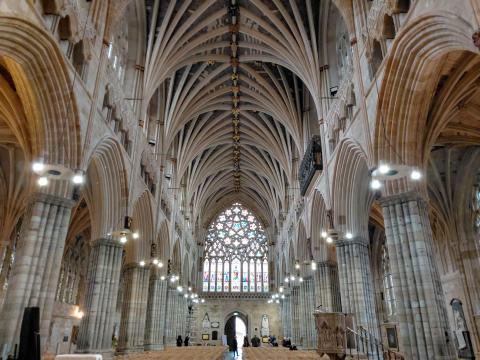
Whosoever therefore shall humble himself as this little child, the same is greatest in the kingdom of heaven. Matthew 18:4
A
- Log in to post comments
 Sunday Worship 10.45am & 6.00pm
