
The Bridesmaid (1883-5)
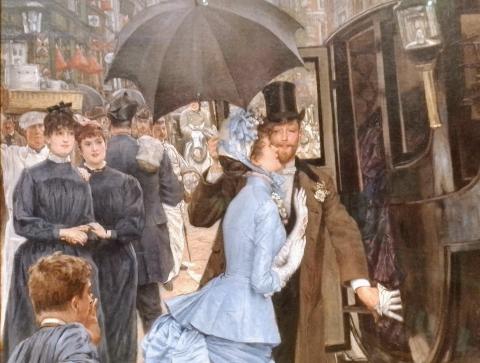
James Tissot’s The Bridesmaid was painted 1883-85 and hangs at Leeds Art Gallery. At first, all seems well: the beginning of a lovely wedding day, which attracts some attention on the street from which its party departs. Yet Tissot has included a red pair of spectacles as an optician’s street sign, an invitation for us to take a closer look. The man is likely the groom, but if the woman in blue is the bridesmaid, why does the groom pay her so much attention? Why is his glove slipping off as he opens the carriage door, and why do her own gloves open to reveal flesh? One wonders where the bride is? -in the carriage? Yet she is remarkable for her absence from the scene (and the groom’s thoughts, presumably). The man’s umbrella seems to be offer discretion as well as shelter from the rain, though the shop girls in black seem to admire the scene regardless. There is a boy on the left foreground calling out to the couple; they are hardly likely to buy his wares, so the content of his admonition is left for us to imagine.
Am I reading too much into the picture? Do I see dark clouds gathering on this bright wedding morn when I should see nothing but happiness and bliss? Perhaps. The picture might be an allusion to Tissot’s own, complicated conjugal relations. In the mid-1870s, he met Kathleen Newton, an Irish adulteress and divorcee with whom he began an intimate relationship. The two moved in together in 1877; the picture may reference her failed marriage or the new couple’s current, questionable circumstance.
Those marriages that survive have not done so because there was a shortage of problems, and any which are pure bliss from the vows onward are painfully curtailed by death, leaving a trail of grief and agony in the heart of the survivor. Thankfully, the Christian is ‘married’ to another, One who can never die, and for whom our deaths signal greater intimacy, not less.
And the Spirit and the bride say, Come. And let him that heareth say, Come. And let him that is athirst come. And whosoever will, let him take the water of life freely. Revelation 22:17
A D
- Log in to post comments

 Sunday Worship 10.45am & 6.00pm