
Family Lessons 165: Bold is the Griffin
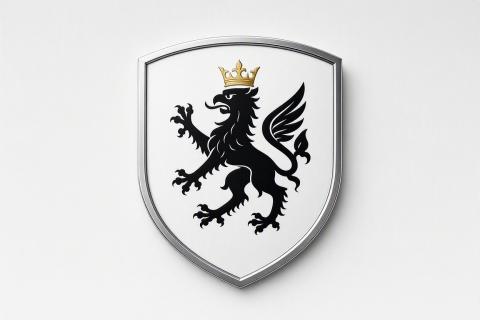
Richard de Bold was my 24x great-grandfather, who died in 1211. He was lord of the manor of Bold which is in old Lancashire but present-day Merseyside. Bold is an odd word for a place and a surname. The Bold Parish Council’s site cheerfully offers the following explanation:
The parish takes its name from the estate of the Bold family who traces its origins back to Anglo-Saxon times before the Norman conquest of 1066. The name Bold is said to have originated with a blacksmith named John Birch who it is claimed killed a Griffin that was terrorising the local area and killing sheep and cattle. After this deed, he was given the title John the Bold and given extensive lands which became the Bold Hall Estate. This is also the reason for the Bold coat of arms featuring a Griffin or Gryphon.
Stephen Dowd, on the other hand, writing for the Newton-le-Willows local history site, suggests in more circumspect style that the name is a simply derived from the Old English bote which means homestead. This is rather more boring, but more plausible, though I prefer the parish council’s assessment. The Bold family crest certainly has that peculiar creature upon it. The Mythical Creatures and Beasts website describes the Griffin thus:
Griffin legends describe a creature that stood as both guardian and warning, combining the strength of a lion with the vision of an eagle. Revered across ancient cultures, it was believed to protect what was sacred while striking fear into those who dared approach. Across ancient civilizations, stories emerged of a powerful being that ruled both land and sky. With the body of a lion and the wings of an eagle, it was seen not only as a creature of strength, but as a symbol of vigilance and divine authority.
It is depicted with the body, tail and back legs of a lion, but the head and wings of an eagle with its talons displayed on outstretched front legs. Pliny, Apollonius of Tyana and Isidore of Seville all entertained opinions of them as though they were real, and certain descriptions of angelic creatures in the book of Ezekiel combine the lion and eagle features. Its heraldic versions, such as that used by the de Bolds, above, bespoke strength, prowess and leadership ('boldness', surely), which made the griffin a popular motif.
Much as I should love to trace my line back before the 'Norman yoke' was imposed and Englishmen enjoyed the wonderful utopia of Saxon England, as well as thinking an ancestor of mine might have rescued a village from some fearsome creature, the whole tale is rather fanciful. John Birch sounds more like a retired geography teacher than a Saxon warrior, though I do hope he was amply rewarded for performing such a feat were it true.
In the twelfth chapter of Revelation, a passage we studied in our evening Bible study last week, we encountered the great serpent which is the devil, or Satan. Fearsome though he is, the book records his eventual doom, and the One who defeats him is not a Saxon nobody, but Christ Jesus Himself, the Lion of the Tribe of Judah and the Root of David. By such an act of judgement, He claims the universe as His own, and a not just a few acres of Old Lancashire.
And he laid hold on the dragon, that old serpent, which is the Devil, and Satan, and bound him a thousand years... Revelation 20:2
A D
- Log in to post comments
 Sunday Worship 10.45am & 6.00pm