
Holy Catholic Church
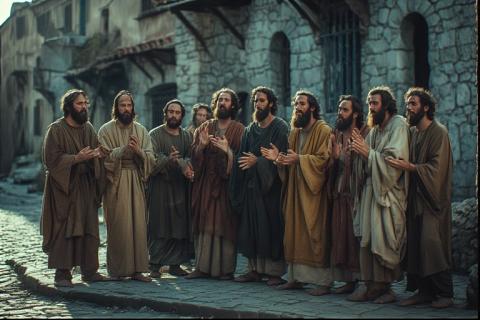
On Sunday morning, we read together the Apostles’ Creed. It is not something we usually do, but I rather like the prospect of doing it several times over the year. This is not because I hanker after liturgical worship (the whole exercise takes less than a minute), nor because I think it an exact summary of all we believe (it neglects justification by faith, for example) and neither do I think it enjoys the authoritative equivalence of scripture (though if it summarises scripture it cannot be much below it). Rather, some of us have been struck by the theological ignorance of so many church-going people for whom even the doctrinal basics prove elusive. If those who hear preaching several times a month cannot rightly comprehend the fundamental tenets of the faith, those who never darken a church door have little chance at all.
I anticipated the usual objections to the phrase ‘I believe in the holy catholic church’ in our decidedly protestant chapel, our regulars rightly baulking at the prospect of Roman Catholicism. I briefly considered offering a defence and justification before we recited but decided that it would spoil the flow and interrupt the otherwise pleasant rhythm of our ’Easter carol service’. Instead, I dealt with the objections afterward.
“It refers to the Roman Catholic Church”
It does not. The word ‘holy’ is used, which the Church of Rome most certainly isn’t. Rome’s is an unholy church, the haunt of demons and idolaters. It may have taken the name, but that does not mean that it owns the word or uses it aright. The Church of Jesus Christ was holy long before popes, Masses and Mariolatry wheedled their way in. Members of the holy, catholic church included John Wycliffe, Jan Huss, Peter Waldo and thousands of others whom the Church of Rome burned or would have dearly loved to. We belong to the same universal church as they, to which the word ‘catholic’ refers.
“The above point might be correct, but the word ‘catholic’ causes too much confusion, so it should be avoided”
This point is more sensible, though I do not think that the cults and the counterfeits should not determine our vocabulary; it is they that hove stolen ours, not the other way round. Using this logic, we should never say Tyndale’s transliteration of God’s covenantal name, Jehovah, on the basis that the Jehovah’s Witnesses have pilfered it. May we not describe our theology as ‘orthodox’ (meaning ‘straight’) because Greek and Russian Orthodoxy, with their chanting priests and ogling icons, have employed it for themselves?
English Protestants did not traditionally use the word ‘catholic’ to describe the Church of Rome or its members. We have departed from their example, referring to them as ‘Catholics’ and their ‘Catholic Church’. It is not the Catholic Church but the Church of Rome, or the Romanist Church. It is Popery and Romanism, its adherents being papists and Romanists. It is our own misuse of the word ‘catholic’ which creates the difficulties of reciting it in the Creed.
“The word is not used in the Bible, so why should we use it?”
Firstly, the scriptures were written in Hebrew, Aramaic and Greek; they included no English words since our language did not exist when the Holy Spirit inspired the writers’ pens. Take this point to its logical conclusion and we must be like the Muslims, each rote-learning Arabic and reciting the text with minimal understanding.
Likewise, Russellists (they prefer to be called ‘Jehovah’s Witnesses’) love to point out that the word ‘trinity’ is not in the Bible, which obviously proves that it is false. This dumb argument is little better than the one used here; we employ single words or phrases to summarise lengthy and complex concepts. One-God-in-Three-Persons-Co-equal-and-Eternal, or even Father-Son-And-Holy-Spirit are both taught in scripture, though the word Trinity trips better off the tongue. It is not whether a word is used, but whether its meaning is taught, that should be the focus of our enquiry. So is the concept of a global, international, inter-dimensional community of redeemed persons a scriptural concept? Yes. Paul commands married men in Ephesians 5:25:
Husbands, love your wives, even as Christ also loved the church, and gave himself for it...
Is he referring to husbands of many wives? Men with lots of girlfriends? Just husbands who loved wives at Ephesus (so married men in other towns needn’t bother with love)? Or just those who were alive when he wrote? No, he refers to all Christian husbands at all times and in all places. Similarly, the church for which Christ gave Himself and loved, was it just the Ephesian? Or those alive at the time? Does it not refer to all Christians of all times and places who make up the gathering of His people? It is certainly not a particular denomination. It is the true church in all its catholicity, times and locations.
Therefore, believe in the holy catholic church with good conscience, while rejecting the lies of the Church of Rome with due diligence.
Here is a Sermon of mine from February 2019 when I preached through the clauses of the Creed.
A D
- Log in to post comments

 Sunday Worship 10.45am & 6.00pm