
Old Grandfather Clock & the Ten-Pence-Piece
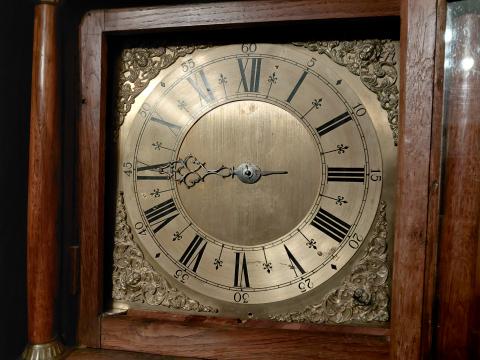
I have managed to acquire a rather old grandfather clock. Of its age I cannot be certain, and it is not a field of antiquity in which I have special expertise, though I have done a little digging in order to gauge its origin. The brass clockface, for example, would commonly date it to between 1680 to 1770 (they became common from 1730 but unpopular from 1780 when painted ones were the fashion), which is my first clue. Furthermore, it has but one hand indicating the hour which is typical for 1660-1720; from 1730, clockmakers routinely added one for the minutes as time pieces became more sophisticated. Its oak case and 30-hour chain‑driven movement simply indicates a date prior to 1800, thus adding little to the overall investigation. So, if I were a gambling man, which I am not, I would settle for a year close to 1700.
Despite its age, or perhaps because of its age, some of its parts are new, including the pendulum’s rod and accompanying time weight. It is therefore an old clock with new parts, much like my uncle who has a new hip and a friend who enjoys a replacement knee. When the clock arrived, the pendulum would only swing for a few minutes before giving up. This is understandable for so old a clock, but still disappointing. Like many old houses (and newer ones, too), the floor is not sufficiently even for the pendulum’s centre of gravity which must be directly beneath its suspension point, the swing of which needs to be correctly balanced with the escapement, ensuring that it receives equal energy in each cycle. The wise old man who supplied the clock suggested that my proposed piece of cardboard stuffed beneath the base would not be required and would look unattractive in any event. Instead, he positioned a ten-pence piece (see the lower left corner of my picture) beneath the brass clockface which conferred a sense of balance and equilibrium to the mechanism, thus enabling regular pendulum swings. For thirty hours now, the clock will work once the chain has been pulled. As far as time-telling is concerned, it is not the most accurate or helpful clock in the room, but in terms of dignity and poise, it is king of all it surveys. This clock is older than my Victorian house and is commensurately delicate and tired. Yet a humble ten pence coin fixed the problem and got the grand old man functioning again.
Here is my ten-penneth. The older I get and the more pastoral visiting I do, the more I have realised that our bodies are so finely tuned that the slightest variation can cause the worst and most painful malfunctions. Older people's bodies are a bit like this clock and yet they are often the most useful in the church: shorn of many responsibilities and freed of formal employment, they may serve the Lord more fully than those with greater reserves of energy but less available time. So if you are old and feeling tired, keep going; you remain on earth because the good Lord has work still for you to do. If you are young with energy and time to spare, heed those older folk whose example the Lord has provided. Someone around the year 1700 manufactured a long case clock which, in the 2020s, still serves a purpose in the home of a Dissenting minister.
They shall still bring forth fruit in old age; they shall be fat and flourishing. Psalm 92:14
A..
- Log in to post comments

 Sunday Worship 10.45am & 6.00pm
