
St Hywyn’s Church, Aberdaron
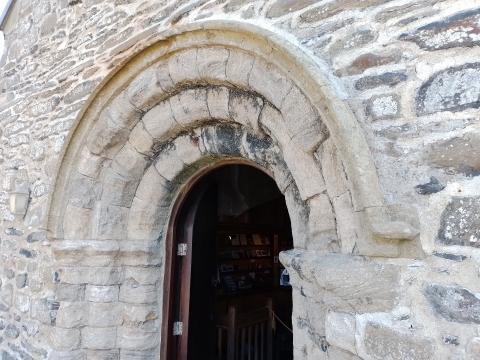
St Hywyn’s Church at Aberdaron in Gwynedd is one of those stately old ladies we church-grabbers are delighted to encounter from time to time. Though very elderly, she retains her dignity; though her heyday is over, her company is still worth the keeping.
Built for the medieval pilgrimage boom in the 1100s and connected to the famous Bardsey Island which I one day hope to visit, the Reformation rendered St Hywyn’s a mere parish church and it duly returned to obscurity. Peculiarly, but not exclusively, it has two naves side by side (our nearest other example would be Brindle), which essentially doubled the floorspace to accommodate the many visitors.
One of the gems within this Welsh trove is even more impressive than the Romanesque door. It is a couple of grave markers, discovered in the eighteenth-century on farmland. They record the resting places of a couple of Christian church leaders from as far back as the fifth century. Although enigmatic, they remain clear to read, though they beg more questions than they deign to answer. This period known as the Dark Ages, sitting between the Romans’ departure and the Anglo-Saxons’ ability to write things down. We know little about what happened then, consequently, though it is now widely understood that Christianity continued to operate on our islands outside of the Church of Rome and independently of its proud Bishop. When translated from the Latin, they read:
'Veracius the presbyter lies here'
and
'Senacus the presbyter lies here with the multitude of brother presbyters'.
The latter may be a corroboration of the claim that Bardsey Island contains the burial of 20,000 Christians.
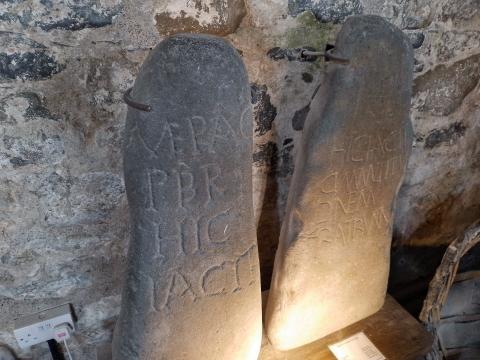
These names are likely Romano-British, belonging to men who missed the security of the Roman legions but continued the worship and work of Almighty God even in their absence. They may have served at the monastery at Capel Anelog, a mile from St Hywyn’s, and which is now a farm.
An old church certainly, but containing links to fellow believers from the embers of the ancient world. As we in Britain appear to enter a new dark age, with paganism triumphant, false religion prospering, churches closing and the old certainties evaporating, these old gravestones remind us that the pilgrim church remains even while the world darkens and dims.
For, behold, the darkness shall cover the earth, and gross darkness the people: but the Lord shall arise upon thee, and his glory shall be seen upon thee. Isaiah 60:2
A D
- Log in to post comments
 Sunday Worship 10.45am & 6.00pm