
Turquoise
: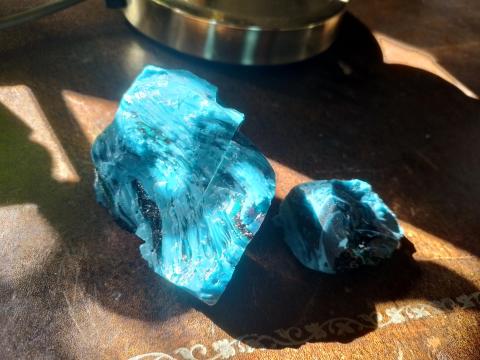
Having had something of an interest in precious stones, the old High Priest’s breastplate has been something that has fired my interest over the years. Unfortunately, the names of the stones do not neatly correspond with our modern names, so identification is hampered. For example, take the stone turquoise, which is pictured above. The NIV positions it as the first stone in the second row, which other translations render emerald; Geneva employs it as the first stone in the third row, while the AV and ESV don’t use it at all:
New International Version:
The second row shall be turquoise, lapis lazuli and emerald; the third row shall be jacinth, agate and amethyst; the fourth row shall be topaz, onyx and jasper. Mount them in gold filigree settings. Exodus 28:18-20
1599 Geneva Bible:
And in the second row thou shalt set an emerald, a sapphire, and a diamond. And in the third row a turquoise, an agate, and an Hematite. And in the fourth row a chrysolite, an onyx, and a jasper: and they shall be set in gold in their embossments. Exodus 28:18-20
We need not be troubled by this; names change over time and the breastplate’s symbolic or theological value is greater than its stones. Its original makers knew which stone the Lord intended and the object is now lost anyway.
Turquoise, whatever its function in or out of the priestly breastplate, is a truly beautiful stone. Although it now denotes a colour, its name is a corruption of the French word for Turkey, from whose Ottoman Empire we began to import it since Elizabethan times. Its source of mining, though, was not Turkey but Persia, modern Iran. Neither nation is officially receptive to the gospel of Jesus Christ: Persia has an authoritarian Shia regime while Turkish secularism is increasingly blending itself with harder interpretations of Islam. It is not just beautiful stones that we have obtained from these lands, but something more precious still: the scriptures. Esther and parts of Daniel were written in the Persian empire and much of Paul’s New Testament letters were written to and from cities in modern day Turkey. Although many of their own peoples may not recognise the beauty of these inspired writings, much less read them and believe them, they really are a more wondrous export than all their turquoise put together.
A D
- Log in to post comments
 Sunday Worship 10.45am & 6.00pm