
Emerald
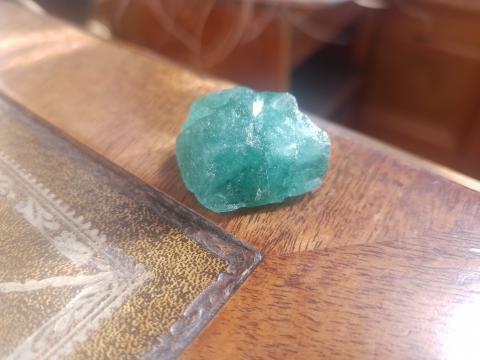
I have in my possession an emerald, measuring just over an inch. It is rough and uncut, so its value is small, and not worth the trouble of breaking into my home to pinch (burglars, take note). It is an attractive green, as one might expect, though it looks especially pretty, rough though it is, when rays of sunlight pass through.
Many Bible translations employ the English word emerald to translate the Hebrew bareqath, though others hesitate and prefer to use carbuncle or beryl, such as when describing the stones of the high priestly breastplate. The Greek word smaragdos used in the New Testament and the Septuagint (the Greek translation of the Old Testament) seems to warrant greater agreement among the translators that it refers to the green coloured gem. Some varieties of emerald are not green, of course, but it is the most common and widely assumed colour. Thus we read in Revelation 21:19 a description of our ultimate heavenly home, New Jerusalem:
The foundations of the wall of the city were adorned with all kinds of precious stones: the first foundation was jasper, the second sapphire, the third chalcedony, the fourth emerald… (New King James Version)
To think that a stone which is so costly and rare on earth should there be as common as concrete is astounding. Even allowing for some poetic licence to enable John to describe an indescribable heavenly abode, the message is clear: our final home shall be beautiful beyond description; shimmering, colourful, sparkling and unrivalled. Only the city’s King will be more beautiful. We also read in Revelation 4:3:
And He who sat there was like a jasper and a sardius stone in appearance; and there was a rainbow around the throne, in appearance like an emerald.
I cannot begin the imagine this splendour; for now, I shall gaze at my little stone and make do, patiently.
A. D
- Log in to post comments
 Sunday Worship 10.45am & 6.00pm