
Family Lessons 163: Exiles from Wales
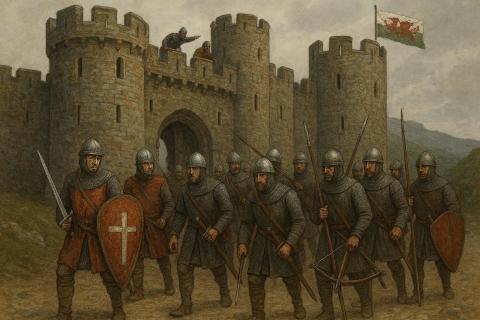
Some research was published in 1921 by R. Stewart-Brown, M.A., F.S.A., and F. C. Beazley, F.S.A. by The Historic Society of Lancashire & Cheshire (vol 73) entitled The Crosse Family of Wigan, Chorley and Liverpool. They suggest that the Crosse Family (or del Crosse, or de la Cruze and other variants) descend from the Waleys Family who lived in that area. Thus my ancestor Richard de le Croyze who died around 1272 was the son or grandson of ‘Robert le Waleys of the Cross of Lathom’, near Ormskirk. They go on to suggest that Robert was a descendant of men who were expelled from Rhuddlan Castle in Wales by Owen Gwynedd when he captured it in 1150, and were obliged to seek refuge in England for their pro-English loyalties. These men of Rhuddlan had settled in the Wirral under their leader Robert Banastre and had moved across to south-west Lancashire by 1177.
The name Le Waleys therefore means ‘the Welsh’, but by the 1200s, their descendants were no longer considered Welsh and dropped the name. The heirs of ‘Robert le Waleys of the Cross of Lathom’ (meaning Robert of Wales who lives by Lathom cross) simply ignored the Welshness but kept the word cross, which became their surname in the centuries to come. This is contrary to an earlier explanation for the name which invokes the crusades, as men who ‘took the cross’ and came back from the holy land to tell the tale. Stewart-Brown and Beazley also note the frequency of names like Adam, Thurstan, Gilbert, Robert and Richard, which were common among Barnastre and his supporters, which were also common among the later Crosse family, lending the theory further support.
When the Le Waleys family emigrated to England they must have been bitterly disappointed and wondered what the future held. Yet it turned out well, for they prospered, their progeny still inhabiting the areas to which they moved. Their Welsh connections and name were lost within a few generations and their new identity as Lancastrian knights and gentry replaced what they had been.
I cannot vouch for the piety of those Anglo-Welsh émigrés from whom I probably descend, but we Christians, like Abraham, are all exiles from our real home, weary travellers passing through this fair of vanity. Though we cannot feel at home, the place to which we are heading will be our home forever, never to be relocated, re-housed or re-assessed again.
By faith Abraham, when he was called, obeyed God, to go out into a place, which he should afterward receive for inheritance, and he went out, not knowing whither he went. Hebrews 11:8, Geneva Bible
A D
- Log in to post comments
 Sunday Worship 10.45am & 6.00pm