
Gloucester Cathedral
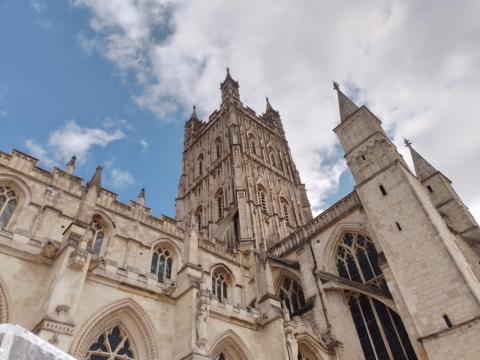
Gloucester Cathedral I called at twenty-five years ago. Then, I had little interest in churches and cathedrals other than the cursory. Returning yesterday, a large choir festival was being planned and rehearsed, which gave the place a rather chaotic and cluttered feel, visitors only allowed to enter after midday, stepping over chairs and discarded barriers.
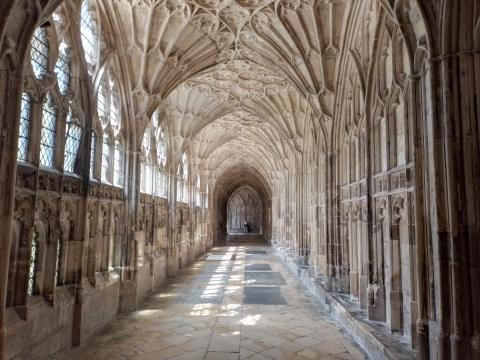
Little about the main cathedral struck me as odd or unusual; I have now seen so many of them that they blur into one. Yet the cloisters’ fan vaulting (bottom) must surely be the most beautiful in the kingdom, if not the world. These were covered walkways around which the old monks could exercise without getting their tonsured heads wet. That there were monks patrolling around these premises reveals that before the Reformation it was St Peter’s Abbey. When Harry Tudor terminated the abbeys and monasteries, he adeptly converted Gloucester’s to cathedral status, the role of abbot replaced by bishop. Although this also happened in the northern city of Chester, it is thought that Gloucester was saved from plunder and destruction because his ancestor lay buried there, King Edward II, below.
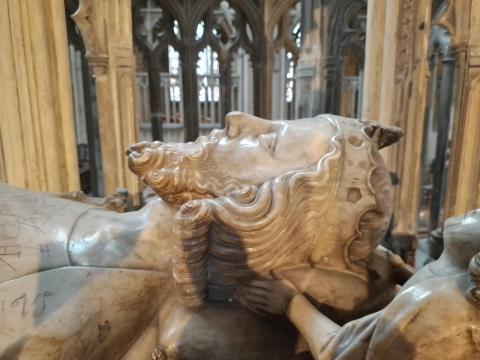
Edwardi Secundi was a tragic monarch whose place of painful murder, Berkeley Castle, I visited the last time I was in the Gloucestershire. Yet Henry VIII, a very different man, may have had sufficient regard for him purely on the basis of blood. Did this save the old abbey? It may be a local legend, but Old Henry was unpredictable and proud enough to allow the possibility.
We tend to think of God conceiving of the gospel (by which I mean His grand plan of redemption) because He could see us (present and future believers) whom He loved from afar, even before our existence. I also wonder if He had a love for Adam which was an ingredient in the deep mystery of God’s motivation. There is no text which expressly records a special affection that God had for His first man, and we might argue that God had a particularly low regard for the one who, though given everything, threw it all away, even though he was without a sinful nature. Yet would God not have a love for Adam, whom Luke describes as His son, which may have confirmed His affection for us? If the ground was cursed ‘for his sake’, was not the Redeemer also promised for his sake? Isaac was blessed for Abraham’s sake in Genesis 26; I wonder if God’s love for foolish Adam was such that He also wished to save His children from the curse and righteous judgement that their actions warranted. Ultimately, our salvation is of the Second Adam, Christ, the life-giving Spirit, and for His sake is the Father’s wrath satisfied. Perhaps the One who desired to walk with Adam in the cool of the evening rescued us as part of the package of love He lavished upon our ancestor.
Old Tudor saved an abbey from his own greed and avarice, but God saved a whole multitude of people for the sake of Christ, and, quite possibly, His compromised shadow, Adam the First, from whose loins we come.
A D
- Log in to post comments

 Sunday Worship 10.45am & 6.00pm