
St Peter's Church, Northampton
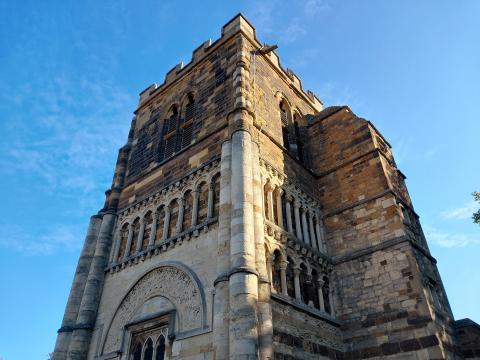
St Peter's Church in Northampton was a cause for both great joy and disappointment when I visited that city this autumn. The joy was upon discovering that it opens on Tuesdays: I travel about on Mondays and Tuesdays and attractions tend to be closed after the weekend. The disappointment came when I waited for it to open but no-one actually bothered to turn up. Now in the custody of the Churches Conservation Trust, St Peter's appears to be as redundant now as the day the Church of England ceased to offer it employment. Even the grounds were fenced off and locked up, as though the wonderful building’s treasure was to be shared with as few folk as possible.
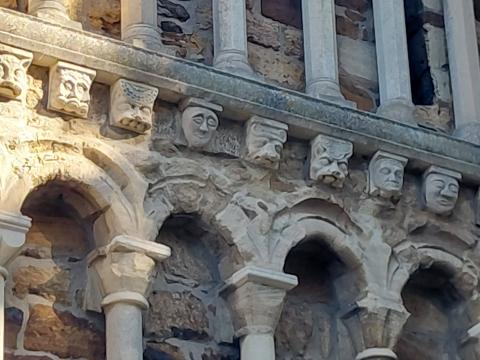
I had to therefore admire it as best I could by circumnavigating the boundary and using the zoom on my modest lens. The tower and nave have a number of the carved heads so beloved of the Normans carved about them. Sometimes, these are demons, animals, people, or weird combinations. So if ever there was a church from which one has to be locked out, St Peter’s at least still provided some visual interest.
Basic online research produces Norman Tanner’s 2004 article for the Oxford Dictionary of National Biography which cites one Anna Palmer who lived in a house right next to St Peter’s. She was an anchoress, which meant that she lived in a confined space in or next to a church using her time for prayer, meditation and dispensing advice. Unusually, Anna was charged with Lollardy in 1393 by John Buckingham, Bishop of Lincoln. Lollards were the evangelical followers of John Wycliffe, a kind of proto-protestantism. She refused to answer the fifteen charges of heresy brought against her on the grounds that the bishop was an antichrist, though a sixteenth charge of ‘incontinence’ she was prepared to deny. I am inclined to consider this a reference to her many words rather than a failure to regulate bowel movements, but she lived close to the church, the users of which may have been in receipt of their close neighbour's odours, so who knows? One of the fifteen charges was that she was a receptrix lollardorum, or a receiver/hostess of lollard heretics. Presumably, she held night time, evangelical meetings or Bible studies in her anchorite house. I suspect that she and her guests felt as excluded from St Peter’s as me, forced to remain outside, but for theological reasons rather than ones of security. Anna was sent to Banbury Gaol and from thence to London for further interrogation from which point she disappears from the historical record. I suspect that calling a medieval bishop an "antichrist" to his face was deemed sufficient evidence of guilt and that her ministry of hospitality for Christ’s disciples came to end, along with her life, in the blazing fires of Smithfield.
An interesting church, for certain, and one whose internal delights may (or may not) be available for examination on some subsequent visit. Yet in the shadow of that tower lived and breathed entities even more interesting: the redeemed people of God, who followed Jesus Christ even through those days of papal darkness .
Blessed be ye, when men shall curse you, and shall pursue you and shall say all evil against you lying, for me.
Matthew 5:11, Wycliffe’s New Testament
A D
- Log in to post comments
 Sunday Worship 10.45am & 6.00pm
