
The Fair Toxophilites (1872)
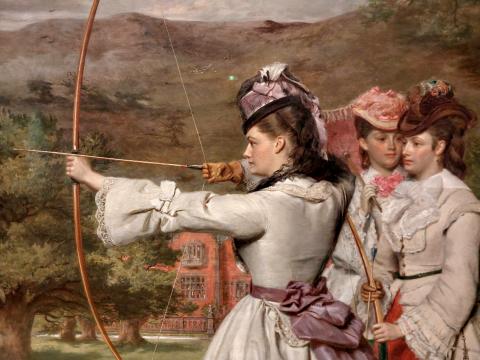
William Frith’s 1872 oil on canvas depicts three young archers as a fanciful representation of his three daughters, Alice, Fanny and Louisa. The work was intended as a novel family portrait and remained with Frith's descendants, rarely exhibited, until acquired by Exeter’s Royal Albert Memorial Museum and Art Gallery in the mid-1970s. Only the one about to shoot has anything resembling expression in her face and even that is questionable. Nevertheless, it is a charming painting and a helpful record of high-Victorian fashion.,
The well-dressed young women do not seem to be helpfully attired for the purposes of archery, with those frills and laces likely getting in the way. Nevertheless, they surely refuse to compromise their femininity for the sake sporting ability.
However I might sneer about Alice’s clothing, that arrow would have proved just as lethal as anything unleased at Agincourt or Crécy. An archer is a most terrifying prospect, especially when you are the intended recipients of the feathered projectile. A medieval archer usually had the advantage over a more powerfully armoured man if he was located more than a halberd’s or pike’s distance. A weak and delicate artist’s daughter has suddenly assumed the powers of a warrior because of that bow.
You might feel spiritually (or even physically weak) and your clothes might not made of silks and cotton rather than steel and padding, but if are able you can pray, you are a greater hazard to the enemy of souls that all the armies of the world.
Submit yourselves therefore to God. Resist the devil, and he will flee from you. James 4:7
- Log in to post comments

 Sunday Worship 10.45am & 6.00pm
